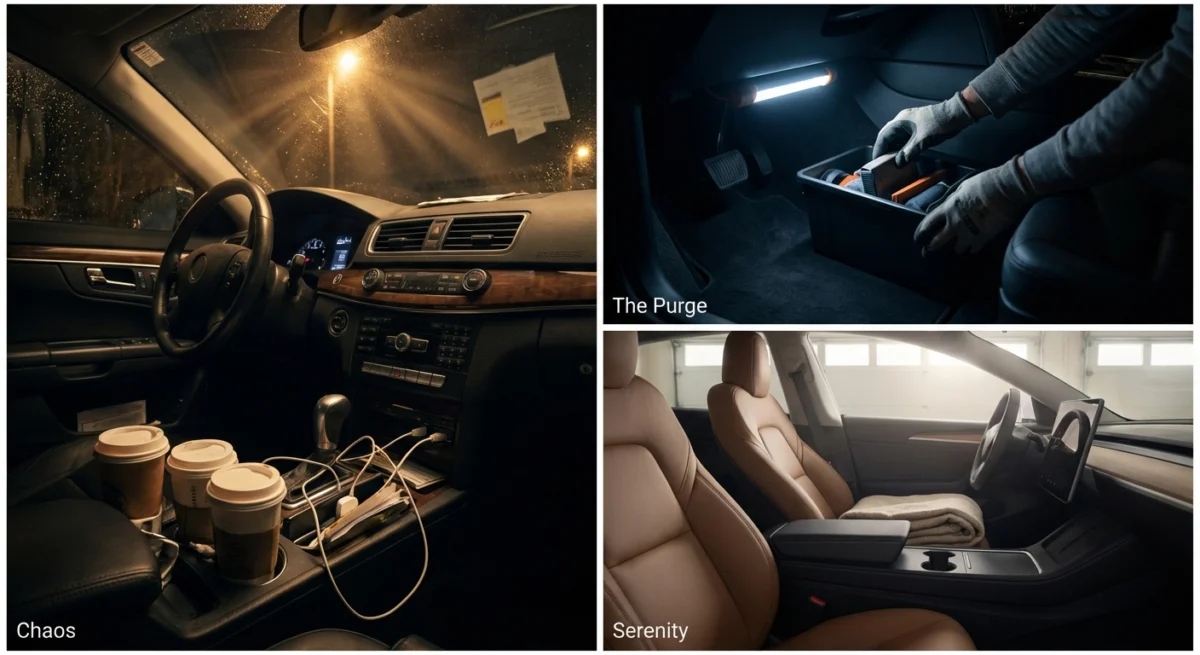
It starts with a single coffee cup in the cupholder. Then, a handful of receipts stuffed into the side door pocket. Before you know it, gym bags, charging cables, and discarded mail have colonized your passenger seat and floor mats. This isn’t just an aesthetic issue; it is a functional degradation of your machine.
Americans spend an average of 17,600 minutes behind the wheel annually. Your vehicle is arguably your second home and frequently your mobile office. Yet, while we wouldn’t tolerate a workspace littered with debris or a living room unsafe to walk through, we often allow our vehicles to become rolling storage units.
As automotive experts, we view interior cabin management as critical as changing your oil. A cluttered car increases driver stress, reduces reaction times due to distraction, and can physically endanger passengers during sudden braking events. This guide moves beyond simple tidying; it provides a comprehensive, systematic approach to decluttering your car interior, restoring the ergonomics, safety, and value of your vehicle.
Understanding Automotive Decluttering: The Methodology
What is Strategic Vehicle Organization?
To the uninitiated, decluttering a car seems like a simple act of throwing away trash. However, from a professional detailing and automotive safety perspective, it is the process of cabin optimization. It involves the systematic removal of non-essential items, the categorization of essential tools, and the implementation of storage solutions that prioritize driver ergonomics.
Think of your car’s interior as a cockpit. Every control needs to be accessible, visibility must be unobstructed, and the environment should support the driver’s focus. When we declutter, we are resetting the vehicle to its factory-intended state of utility. This process separates the “active inventory” (items needed for the drive) from “static accumulation” (items that have migrated from the home or office and stagnated).
How the Accumulation Cycle Works
Clutter accumulates through a phenomenon known as displacement. Objects enter the vehicle for a specific trip but fail to leave upon arrival. Over time, the vehicle transitions from a mode of transportation to a mode of storage. This creates layers of debris:
- Surface Layer: Recent trash, cups, and wrappers.
- Sedimentary Layer: Papers, mail, and clothing that have been stepped on or pushed under seats.
- Hidden Layer: Items in the glove box, center console, and trunk that haven’t been touched in months or years.
Breaking this cycle requires a “hard reset” followed by a maintenance protocol, much like detailing the exterior paint to remove oxidation before applying wax.
The Tangible and Intangible Benefits
Safety and Projectile Mitigation
The most critical reason to declutter is safety. In the event of a collision or hard braking, loose objects become unsecured projectiles. According to physics, an object’s weight multiplies largely by the G-force of the impact. A standard laptop sitting on the rear parcel shelf can strike a passenger with the force of a sledgehammer during a high-speed crash. By securing loose items and removing clutter, you are actively reducing the risk of blunt force trauma in an accident.
Furthermore, floor clutter presents a catastrophic mechanical risk. A loose water bottle or tennis ball rolling under the driver’s seat can easily lodge itself behind the brake or accelerator pedal, preventing the driver from stopping the car.
Resale Value Preservation
A cluttered car is a depreciating car. Debris trapped against upholstery and carpet fibers acts as an abrasive. Every time you shift in your seat or step on the floor mat, that debris grinds into the material, causing premature wear, tears, and staining.
When it comes time to sell or trade in the vehicle, interior condition is a primary factor in the appraisal. A cabin that smells fresh and looks well-maintained suggests to the buyer that the mechanical components were likely treated with similar respect. Conversely, a cluttered, stained interior signals neglect, potentially knocking thousands of dollars off the resale value.
Mental Clarity and Cognitive Load

There is a direct psychological correlation between visual clutter and cognitive load. A messy visual field competes for your brain’s attention, increasing cortisol levels and inducing low-level anxiety. When driving, you need 100% of your focus on the road. A minimalist, organized driver cockpit reduces visual noise, allowing for a calmer, more reactive driving experience.
The Step-by-Step Execution Guide
Phase 1: The Total Evacuation
Do not attempt to declutter while items are still inside the car. To truly reset the space, you must perform a complete evacuation.
1. Select Your Staging Area: Open all doors and the trunk in a driveway or garage with ample space. 2. Remove Everything: Strip the car entirely. This includes floor mats, car seats (if feasible), items in the door pockets, glove box contents, center console items, and trunk cargo. 3. The Shake Out: Remove the floor mats and shake them vigorously outside to dislodge loose dirt and rocks before vacuuming.
Phase 2: Categorization and Deep Cleaning
Once the car is empty, you have a blank canvas. Before putting anything back, this is the ideal moment for a deep interior clean. Vacuum the crevices that are usually blocked by clutter. Wipe down the dashboard and console surfaces.
Sort the items you removed into four distinct piles:
- Trash: Wrappers, old receipts, broken items, and expired paperwork. Be ruthless here.
- Relocate: Items that belong in your house, garage, or office (jackets, mail, toys, non-automotive tools).
- Essential: Registration, insurance, tire pressure gauge, jumper cables, emergency kit.
- Seasonal/Occasional: Snow scrapers, umbrellas, reusable grocery bags.

Phase 3: Strategic Re-Introduction
Only the “Essential” and necessary “Seasonal” items should return to the vehicle. Re-introduce them using a zone-based approach:
- Zone 1: The Glove Box. This is for documentation only. Owner’s manual, registration, and insurance card. Avoid stuffing napkins or condiments here.
- Zone 2: Center Console. This is “prime real estate” for items you need while driving. Sunglasses, charging cable, and perhaps hand sanitizer.
- Zone 3: Door Pockets. Reserve these for trash management (if using a small bin) or a specific tool like a flashlight or window breaker. Do not use these for paper accumulation.
- Zone 4: The Trunk. This is for payload and emergency gear. Use a dedicated organizer to keep these items from rolling around.
Top Buying Factors for Car Organizers
Since you cannot buy “decluttering” itself, you must buy the tools that facilitate it. The market is flooded with cheap organizers, but as an expert, I recommend looking for specific criteria to ensure longevity and safety.
Material Quality and Rigidity
Avoid flimsy, unstructured fabric organizers. When looking for a car trunk organizer, prioritize items with rigid sidewalls and reinforced base plates. If the organizer collapses when it isn’t full, it contributes to the mess rather than solving it. Look for high-denier polyester (600D or higher) which is resistant to tearing and easy to wipe clean.
Anti-Slip Features
Safety and stability are paramount. A storage bin that slides across the trunk during a turn defeats the purpose. Look for organizers equipped with Velcro strips on the bottom that grip the trunk carpet, or rubberized non-slip feet. For seat organizers, ensure the strapping system is robust and doesn’t interfere with the passenger’s comfort or the deployment of side-impact airbags.

Fitment and Vehicle Specificity
While universal organizers are common, vehicle-specific solutions often provide better utilization of space.
- Seat Gap Fillers: These prevent phones and keys from falling into the “Bermuda Triangle” between the seat and the center console. Ensure the filler matches your interior color and seat contour.
- Visor Organizers: Ensure they fit tightly and do not obstruct your view of the road.
- Console Trays: Many deep center consoles are bottomless pits. Aftermarket “drop-in” trays can double your usable space by creating a tiered storage system for small items like coins and keys.
Accessibility vs. Capacity
Don’t buy the biggest organizer available if it hinders access to the spare tire or blocks your rearview visibility. The goal is ergonomic efficiency. A smaller, well-compartmentalized unit is often superior to a massive bin that encourages hoarding.
Maintenance and Long-Term Care
Achieving a decluttered car is an event; keeping it that way is a habit. To maintain a pristine interior, you must adopt a maintenance mindset similar to checking your tire pressure.
The “One-In, One-Out” Rule
Adopt a strict policy: for every non-essential item that enters the car, one must leave. If you bring a coffee cup in, it leaves with you when you park at home. If you bring a jacket for a cold morning, take it inside that evening. This prevents the slow creep of accumulation.

The Refueling Ritual
Use your time at the gas station or EV charging station as a “micro-cleaning” session. While the pump is running, take two minutes to: 1. Empty the door pockets of trash. 2. Toss out empty bottles. 3. Check the back seat for displaced items. Since you are already stopped and standing by a trash can, this is the most efficient time to perform preventative maintenance.
Seasonal Resets
At the change of every season (twice to four times a year), perform a “Phase 1” evacuation again. Swap out winter gear (scrapers, blankets) for summer gear (sunshades, water bottles). This ensures you aren’t hauling unnecessary weight, which, theoretically, even helps marginally with fuel economy.
Frequently Asked Questions
1. How do I handle trash if I spend hours in my car every day?
Invest in a dedicated, sealed car trash can. Do not rely on plastic grocery bags hanging from a shifter. Buy a leak-proof, lidded container that straps to the back of the passenger seat or sits on the floor hump in the rear. The lid is crucial to trap odors and keep the visual clutter hidden. Empty it every time you fill up your gas tank.
2. What is the best way to organize a car with children?
Children are entropy generators. The solution is “compartmentalization.” Install backseat organizers with dedicated slots for tablets, snacks, and toys. This gives the child ownership of their space. Furthermore, keep a collapsible laundry basket in the trunk. When you arrive home, throw all the loose kid-gear into the basket and carry it inside in one trip.

3. Can I store important documents in the car safely?
While you need your registration and insurance, never store the vehicle title (pink slip) in the car; that is a gift to thieves. For maintenance receipts and insurance papers, use a slim document folio that fits in the glove box. This prevents papers from crumpling and tearing.
4. How do I manage cable clutter for phone chargers?
Cable clutter is a major annoyance in modern vehicles. Use adhesive cable clips to route the wire along the trim so it doesn’t dangle near the shifter. Alternatively, invest in short (6-inch to 1-foot) cables intended specifically for car use, or use a retractable charging cable to eliminate slack.
5. What should I do with “emergency” items that take up too much space?
Consolidate. Many pre-bought emergency kits are bulky plastic boxes filled with air. Remove the contents (jumper cables, first aid, flares) and pack them tightly into a soft-shell canvas tool bag or a specific compartment in your trunk organizer. This reduces the footprint while keeping the tools accessible.
Conclusion
Decluttering your car interior is about reclaiming your space. It transforms your vehicle from a chaotic storage locker into a precision machine designed for travel. By following the protocols of evacuation, categorization, and strategic organization, you not only improve the aesthetics of your interior but also actively enhance your safety and preserve your investment.
A clean car drives better—not because the engine has changed, but because the driver has. Start today by emptying those door pockets; your future self, miles down the road, will thank you for the clarity.